
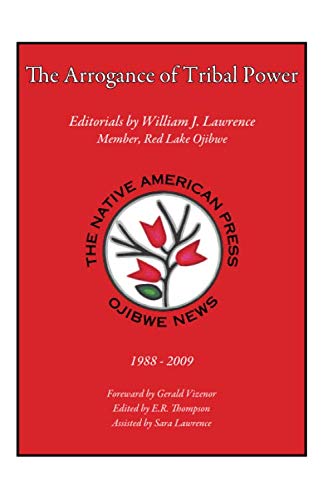
The Arrogance of Tribal Power
Product details
| Management number | 231638050 | Release Date | 2026/06/18 | List Price | US$4.26 | Model Number | 231638050 | ||
|---|---|---|---|---|---|---|---|---|---|
| Category | |||||||||
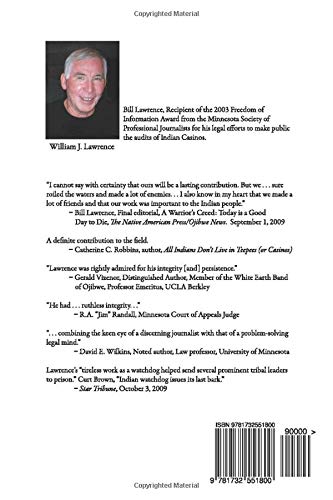
The Arrogance of Tribal Power is a collection of editorials by William J. Lawrence, member of the Red Lake Band of Minnesota Ojibwe, and owner/publisher of The Native American Press/Ojibwe News, 1988-2009. Lawrence’s editorials reveal concerns derived from many years of observing the realities of reservation life.Lawrence asserted, “one of the biggest needs in Indian Country is a free press.” The newspaper “was born out of the frustrations of the Native Community in dealing with the secrecy, rights abuse and unaccountability of tribal governments. Our mission is to expose tribal corruption, defend civil rights, demand accountability and promote a better way of life for tribal people.“Tribal members, risking their own livelihoods and safety, supported the paper by providing documents and information regarding tribal malfeasance. Lawrence protected his sources and fearlessly published insider information concerning life and politics on Minnesota Indian reservations.He was frequently condemned by tribal officials for publishing reliable, but sometimes undocumented information. He was, however, as often defended as a courageous spokesman for tribal members. Despite threats, boycotts and defamation, he steadfastly published the newspaper for twenty-one years. He believed that if reservation circumstances were known, reform would be a given.In 2017 tribal casino revenue amounted to $30 billion. The federal allocation to Indian tribes was $20 billion. Despite the availability of $50 billion to meet the needs of the approximately one million Natives who continue to live on reservations, many tribal members live in third world conditions, subject to the dictates of corrupt tribal governments.Reservations are closed societies where secrecy can prevail. Because of the difficulty involved in obtaining and/or verifying the facts of reservation life, the mainstream press has not had the opportunity to cover reservation news. Mainstream ignorance of the facts of reservation life may be understandable given the general lack of information available regarding conditions endured by reservation natives.Increasingly available, electronic media/interactive communication could raise awareness of need and supply remedies to the situation. Information/communication, heretofore unavailable, will be invaluable to the process. Electronic media is now enabling unrestricted communication by natives on reservations, between reservations, and with the outside.Native populations will now have the means to disclose their reality in a fear-free way and to give direction as to what should/could be done to provide needed remedies. Information exchange can reveal what is available to others that is being withheld from them. Discussion of possibilities for reform, exchange of experiences endured and the viable remedies is now a possibility.Americans are generally predisposed to crusade against observable wrong. Interactive electronic communication could provide the means by which reservation natives can provide the information necessary to inspire intervention by the outside. Re-issuance of Lawrence’s editorials, by providing information heretofore not readily available, could be a catalyst to reform measures. As 95% of Native American newspapers are tribally owned, the 21 year run of The Native American Press/Ojibwe News is truly a singular accomplishment for an independent, privately owned and funded Native American newspaper in Indian Country.Native Americans on some reservations are like victims of distress, who are situated with the possibility of a rescuing body within calling distance, but the rescuers are unaware of their danger and therefore unresponsive. Read more
Bestseller ranking
Indigenous Peoples



Customers who viewed this product also viewed
Incontinence Underwear for Women - Small





Correction of product information
If you notice any omissions or errors in the product information on this page, please use the correction request form below.
Correction Request Form